From Africa/Climate & energy tech/Nigeria · South Africa
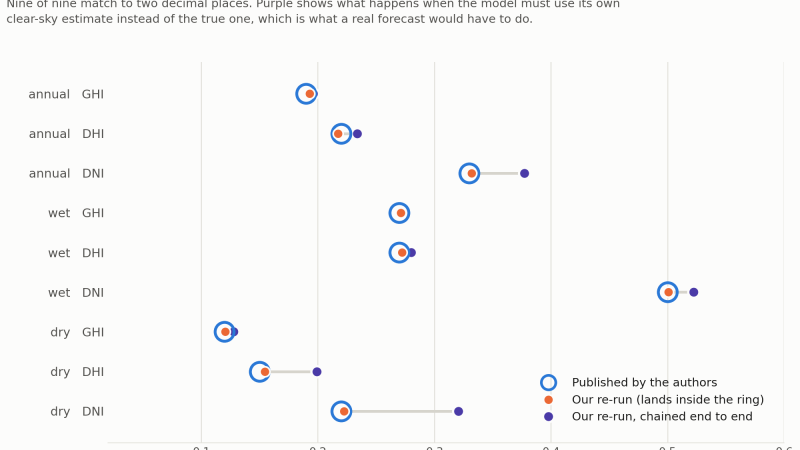
We downloaded the code behind a solar forecasting paper and ran it again. All nine published figures matched. Then we measured the one thing the paper does not.
Business Ideas/Edge computing/China · Nigeria · Singapore · South Africa · United Kingdom
A chip design claims 19 times the AI work per watt of an H100, and it draws as little as 122 milliwatts. Power, not speed, is the limit for AI on small devices, and that is a business.
Business Ideas/Biotech & health tech/Canada · USA
A model shipped into rural Cote d'Ivoire called half the healthy samples infected. Four hours of local labelling fixed it, and that fix is something you can sell.
Business Ideas/Agritech/Ethiopia · Tanzania
Two African labs built crop disease models that run on a phone with no signal. The business is not the model, it is the shop counter where a dealer guesses today.
Business Ideas/Climate & energy tech/Nigeria · South Africa
Ordinary weather records forecast hourly sunlight in Ibadan with a yearly error of 0.19, using free public code. The buyer is the operator deciding tonight about the generator.
Data/Agritech/Ethiopia
An offline crop disease model scored 97.3 percent on cactus-fig photos taken at university test plots. No farmer has ever used it, and the paper describes that figure two different ways.
From Africa/Climate & energy tech/Nigeria · South Africa
A Random Forest model turned ordinary weather records into hourly sunlight forecasts for one site in Ibadan, Nigeria. Its yearly error on total sunlight was 0.19.
From Africa/Agritech/Tanzania
A Tanzanian team trained a Vision Transformer on 100,000 bean leaf images, adding tiny nudges made to fool it. Accuracy rose from 97.4 percent to 99.4 percent.
From Africa/Biotech & health tech/Côte d'Ivoire · USA · Canada
A team in Cote d'Ivoire relabelled a day of microscope images, retrained the model overnight, and tested it the next morning. Its catch rate rose from 75.5 to 98.1 percent.
From Africa/Agritech/Ethiopia
A team at Mekelle University in Ethiopia photographed 3,587 cactus-fig pads and trained three models on them. The best scored 97.3 percent and fits in 9.3 MB.
Explainer/Internet of Things/Kenya
The Internet of Things is everyday objects that sense, report and act without a person watching. Learn what is inside one, how they connect, and why upkeep sinks more projects than technology does.
Explainer/Cybersecurity/Kenya
Phishing is the scam behind most break-ins, and it aims at you rather than your computer. Learn how it works, how to spot a fake message, and what to do if you have already clicked.